Showing posts with label Bloomberg. Show all posts
Showing posts with label Bloomberg. Show all posts
Tuesday, 11 December 2018
Are Shariah Stocks A Shelter During Financial Crisis ? - Part 1
Investors looking for a safe haven in turbulent financial markets should consider Islamic equities, according to a recent study.
Restrictions on debt and the diverse investment goals for Shariah-conscious shareholders could help provide a shelter in a time of crisis, academics including Sohel Azad of Melbourne’s Deakin Business School wrote in the November issue of the Journal of International Financial Markets, Institutions and Money. There are also differences in Islamic market structure that mean assets might be slow to respond to the effect of a downturn, they indicated.
“The interplay of these three forces can allow Islamic indices to behave differently from conventional ones, especially during a financial crisis, making them a good hedge,” the authors wrote. “We suggest that during major economic and financial crises, investors could use Islamic stocks to diversify their risks.”
For more details, Find Shelter From Financial Crisis in Shariah Stocks, Study Says
In the next post, we shall look at the performance of FBM indices - Shariah and Non-Shariah.
Source :
1) www.bloomberg.com

Tuesday, 15 August 2017
Wynn Macau Ltd (HKSE : 1128) / MGM China Holdings Ltd (HKSE : 2282)
Despite the recent positive news on a rebound in Macau's casino revenue, it failed to uplift Wynn Macau Ltd and MGM China Holdings Ltd stock price.
In fact, the stock price for both counters pullback and broke all the S-Trader Trend Tracker support levels before the news was published by Bloomberg.


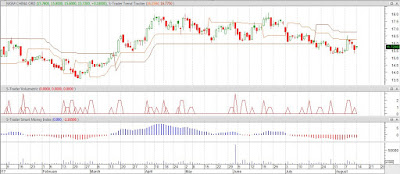
Related post, Macau casinos’ revenue up
Note : S-Trader indicators/tools are not part of Metastock software package. It is our proprietary system/tools. If you have any further inquiries, please feel free to Contact Us.
Source :
1) Metastock
2) Bloomberg
In fact, the stock price for both counters pullback and broke all the S-Trader Trend Tracker support levels before the news was published by Bloomberg.

Daily chart of Wynn Macau.

Daily chart of MGM China.

Note : S-Trader indicators/tools are not part of Metastock software package. It is our proprietary system/tools. If you have any further inquiries, please feel free to Contact Us.
Source :
1) Metastock
2) Bloomberg
Monday, 14 August 2017
Short seller threat has HK rally skipping small caps
Hong Kong stocks
may be Asia’s star performers this year, but it hasn’t done much to
revive the fortunes of the market’s perennial underdogs: small-cap
shares.
A
peek under the hood of the Hang Seng Index’s 25% surge shows it’s being
dominated by larger equities, with smaller companies trading at their
biggest price discount to the big caps since 2009. That’s despite
expectations a trading link between Hong Kong and Shenzhen set up in
December would lure mainland money into the former British colony’s
smaller shares.
For Hao Hong, the Bocom
International Holdings Co strategist who called China’s boom-and-bust
equity cycle in 2015, the lack of appetite for small caps comes down to
two things: the economy and short sellers.
There are signs China’s economic momentum is waning, read more here.
“In a slowing environment, big caps
tend to outperform,” he said, adding that they’re more liquid, often
have higher dividend yields and can be more transparent. “Investors are
avoiding small caps due to concerns about short selling - it seems that
short sellers are increasingly interested in small caps in Hong Kong.”
Short
sellers have taken on at least four Hong Kong-listed companies this
year, among them snack maker Dali Foods Group Co and furniture company
Man Wah Holdings Ltd, a target of well-known short-seller Carson Block.
According to Hong, there were only about two short targets a year in
Hong Kong before 2014, when the numbers started to pick up.
Small-cap
shares also bore the brunt of a selloff in June, when concern over
cross-shareholdings inflating their valuations spurred a cascade of
losses in a group of stocks.
“Fears about
increased short-selling activities around small caps in Hong Kong are
definitely part of the reason for investors avoiding small caps this
year,” said Francis Cheung, head of China-Hong Kong strategy at CLSA
Ltd.
Conversely,
money coming in to the market via exchange-traded funds and support
from China’s government-backed funds, known as the ‘national team,’ have
fuelled big-cap gains, Cheung said.
But
it’s been mainland investors which have propelled the wider Hang Seng’s
outperformance this year, as stricter capital controls make the stock
connects between Shanghai, Shenzhen and Hong Kong one of the only ways
those onshore can get their money into foreign currency.
Net
flows in to Hong Kong via the links have come in at more than 240
billion yuan (US$36bil) this year, versus 131 billion yuan for the same
period of 2016, when the Shenzhen connect didn’t exist.
While
onshore cash is still flocking to Hong Kong, small caps aren’t the
attraction. Of the top 10 stocks in which mainland investors hold the
highest stakes via the Shanghai and Shenzhen trading links, only two -
Guangzhou Baiyunshan Pharmaceutical Holdings Co and China Molybdenum Co
Ltd - are members of the Hang Seng small cap gauge.
Source :
1) www.thestar.com.my
2) Bloomberg
Friday, 11 August 2017
Asia Investors get picky as earnings estimates weaken
One of the pillars supporting a rally in developing-nation stocks is starting to look shaky, at least in some parts of Asia.
Along with robust economic growth and relatively low valuations, improving earnings have pushed the region’s shares to levels unseen in almost a decade.
But Credit Suisse Group AG is sounding a note of caution, saying steep gains in South Korean income projections are masking declines in other markets.
While the consensus earnings estimate for the MSCI Asia ex-Japan Index is 7.5% higher since June 2016, that reverses to a 1 % decline if Korean equities are taken out, the Swiss-based bank said in a July 19 note.
One-year forward earnings per share estimates for Philippine and Malaysian companies in the gauge are down 26% and 5.9%, respectively, in dollar terms over the period, according to data compiled by Bloomberg.
That’s prompting a more selective approach from some investors.
“If we don’t get any upgrades it will be harder for the market to push higher as it’s no longer cheap,” said Joshua Crabb, head of Asian equities at Old Mutual Global Investors in Hong Kong, whose Asian stocks fund has returned 25% over the past year to beat more than three-quarters of its peers. “This earnings season will be important to see where the beats will be.”
South Korean and Philippine banks can still see some gains, while Indian and Indonesian infrastructure stocks remain attractive, Crabb said.
The main driver for downgrades in Asia ex-Japan is “expensive” Indian and Indonesian equities, Credit Suisse strategists Sakthi Siva and Kin Nang Chik wrote in the note.
The lender said it was “underweight” those markets, along with Malaysia and the Philippines.
Along with robust economic growth and relatively low valuations, improving earnings have pushed the region’s shares to levels unseen in almost a decade.
But Credit Suisse Group AG is sounding a note of caution, saying steep gains in South Korean income projections are masking declines in other markets.
While the consensus earnings estimate for the MSCI Asia ex-Japan Index is 7.5% higher since June 2016, that reverses to a 1 % decline if Korean equities are taken out, the Swiss-based bank said in a July 19 note.
One-year forward earnings per share estimates for Philippine and Malaysian companies in the gauge are down 26% and 5.9%, respectively, in dollar terms over the period, according to data compiled by Bloomberg.
That’s prompting a more selective approach from some investors.
“If we don’t get any upgrades it will be harder for the market to push higher as it’s no longer cheap,” said Joshua Crabb, head of Asian equities at Old Mutual Global Investors in Hong Kong, whose Asian stocks fund has returned 25% over the past year to beat more than three-quarters of its peers. “This earnings season will be important to see where the beats will be.”
South Korean and Philippine banks can still see some gains, while Indian and Indonesian infrastructure stocks remain attractive, Crabb said.
The main driver for downgrades in Asia ex-Japan is “expensive” Indian and Indonesian equities, Credit Suisse strategists Sakthi Siva and Kin Nang Chik wrote in the note.
The lender said it was “underweight” those markets, along with Malaysia and the Philippines.
“India just doesn’t have earnings power at all,” Ajay Kapur, head of Asia Pacific and global emerging market strategy at Bank of America Merrill Lynch in Hong Kong, said in an interview with Bloomberg TV’s Yvonne Man.
The firm wants to see an increase in earnings before committing to the market, he said.
Advanced-nation shares are around a third more expensive than developing-country counterparts, based on a comparison of 12-month price-to-earnings ratios for MSCI Inc’s world and emerging-market gauges.
Even so, valuations for some emerging markets are high on an historical basis.
The ratio for India’s Sensex measure is near
the strongest in nine years at 18.8, and that’s also 24% above the
five-year average.
Indonesia’s exceeds its five-year average by 6.4%.
Foreign funds have pulled a net US$823mil from Indonesian shares this month, set for the biggest outflows since November.
The pace of investment is slowing for some other markets.
The pace of investment is slowing for some other markets.
India has lured US$581mil in July, compared with US$2.2bil of net purchases over the previous two months, while Malaysian equities attracted just under US$200mil since May, set for the weakest two months this year.
The FTSE Bursa Malaysia KLCI Index fell 0.1% as of 12:40 pm in Kuala Lumpur yesterday. The Philippine Stock Exchange Index declined 0.9% , while the Jakarta Composite Index rose 0.1% and the S&P BSE Sensex Index climbed 0.2%.
Source :
1) www.thestar.com.my (Published on 1 August 2017)
2) Bloomberg
Consumers probably spent enough last quarter to help US growth rebound from a tepid start of the year. The rest of the economy is giving less of a lift, and the pickup is unlikely to last.
Gross domestic product expanded at a 2.5% annualised rate from April to June, according to the median estimate in a Bloomberg survey ahead of figures due on Friday.
While that would be an improvement over the first quarter's 1.4%, some of the upswing owes to the dissipation of temporary factors such as low heating bills, delayed tax refunds and volatility in inventories.
Meanwhile, a gangbusters pace of business investment earlier in 2017 may have eased to a more sustainable rate.
It adds up to a first half where the economy looks much like it did in years past, growth of around 2%, with consumption doing the heavy lifting.
The pace is in line with that of the eight-year expansion, even though President Donald Trump's election victory had sent US consumer and business sentiment soaring on hopes that lawmakers would loosen regulation, lower taxes and boost infrastructure spending - moving growth toward Trump's 3% goal.
Now reality is setting in with some of the post-election bouyancy retreating amid Washington gridlock on health care and taxes.
While a solid job market has helped underpin growth, wage gains remain modest, and key measures such as auto sales and business-equipment orders have been slower than forecast in recent months. Economists see US growth easing back to around the average of this expansion following the second quarter.
"It's hard to become too optimistic when you're talking about an economy that's running at about 2%," said Michelle Meyer, head of US economics at Bank of America Corp in New York.
"There's very little chance for much accleration. Nonetheless, growth is ongoing. The unemployment rate has gone down, job growth is fairly steady and the consumer should continue to spend."
Consumer spending, which accounts for about 70% of GDP, probably accelerated to a 2.9% annualised pace of growth in the second quarter after a 1.1% rate in the prior period that was the weakest in almost four years, based on the median estimate of economists.
Source :
1) Bloomberg
2) www.thestar.com.my (Published on 28 July 2017)
Sunday, 9 July 2017
Noble Group (SGX : CGP) - More Upside ?
Noble Group, the commodity trader that's struggling for survival after a multiyear stock rout, losses and concerns it may default, surged in Singapore, with the shares heading for the highest close since May amid speculation that an investor may be building a stake.
More news, Noble Group surges amid speculation of stake build
Daily chart.

Note : S-Trader indicators/tools is not part of Metastock software package. It is our proprietary system/tools. If you have any further inquiries, please feel free to Contact Us.
Source :
1) Metastock.com
2) www.straitstimes.com
3) Bloomberg
Thursday, 29 June 2017
Hong Kong small cap stock plunge wipes out HK$42b in value
A string of Hong Kong stocks suddenly plunged Tuesday, with traders
pointing to links between some of the companies and a brokerage that's
under regulatory investigation.
Sixteen firms tumbled by more than 40 per cent as of 2.46pm, losing a combined HK$42 billion (S$7.47 billion) in market value. China Jicheng Holdings Ltd, an umbrella maker, and GreaterChina Professional Services Ltd sank more than 90 per cent. Lerado Financial Group Co., whore shares were halted by Hong Kong's securities regulator this month, has previously disclosed an investment in China Jicheng and an underwriter role on a GreaterChina share placement in 2015.
The broader Hong Kong market was resilient to the declines on Tuesday, with the benchmark Hang Seng Index losing 0.1 per cent and the Hang Seng Composite Small Cap Index sliding 0.4 per cent. Still, the picture looked more grim on the city's small-cap Growth Enterprise Market, which is home to some of the plunging shares.
The S&P/HKEX GEM Index sank 9.6 per cent, its biggest retreat since August 2015, and closed at its lowest level on record. The gauge has lost more than 90 per cent since 2000.

More news, Hong Kong small cap stock plunge wipes out HK$42b in value
Source :
1) www.businesstimes.com.sg
2) www.bloomberg.com
Sixteen firms tumbled by more than 40 per cent as of 2.46pm, losing a combined HK$42 billion (S$7.47 billion) in market value. China Jicheng Holdings Ltd, an umbrella maker, and GreaterChina Professional Services Ltd sank more than 90 per cent. Lerado Financial Group Co., whore shares were halted by Hong Kong's securities regulator this month, has previously disclosed an investment in China Jicheng and an underwriter role on a GreaterChina share placement in 2015.
The broader Hong Kong market was resilient to the declines on Tuesday, with the benchmark Hang Seng Index losing 0.1 per cent and the Hang Seng Composite Small Cap Index sliding 0.4 per cent. Still, the picture looked more grim on the city's small-cap Growth Enterprise Market, which is home to some of the plunging shares.
The S&P/HKEX GEM Index sank 9.6 per cent, its biggest retreat since August 2015, and closed at its lowest level on record. The gauge has lost more than 90 per cent since 2000.

More news, Hong Kong small cap stock plunge wipes out HK$42b in value
Source :
1) www.businesstimes.com.sg
2) www.bloomberg.com
Sunday, 25 June 2017
Life in Hong Kong Is Harder Than Ever - Unless You're a Tycoon
The wealth gap in Hong Kong has becoming a great issue in recent times. If you do a google seach, there are few reported news in the past few years.
Firstly, I would like to share some interesting statements from a news reported about a year ago. It was an interview with Hong Kong's richest man - Li Ka-shing conducted by Bloomberg Television's Angie Lau. His first interview with international media since 2012.
As noted below.
Hong Kong's richest man called for higher corporate taxes to help teckle wealth inequality and urged the government to think of ways of countering rising discontent among its younger residents by providing them with more opportunities.
"Tax companies an extra one or two per cent, then a lot of the poor would benefit"
Unlike Mr Buffett and Mr Gates, Mr Li opposed the idea charging higher tax rates for the rich.
"You mustn't tax some people more and some people less or else it's chaos," he said.
More news, Hong Kong's richest man calls for higher tax to ease wealth gap
Coming back to our post title.
Here are some interesting statements extracted from the recent news article.
Originally intended to stimulate entrepreneurial dynamism, the hands-off approach may have ended up having a perverse effect, allowing a few large companies to entrench their positions and ultimately stifle competition. Charges of collusion between business and government have felled several officials and led to public discontent.
Debates about Hong Kong's rich and poor tend to come back to one word: land.
Almost all the city's richest people largely owe their fortunes to real estate development. The wealthiest is Li, whose Cheung Kong Property Holding's Ltd. posted HK$18 billion in underlying profit last year. The runner-up is Lee, whose Henderson Land Development Co. made HK$14.2 billion. The assets of the 10 wealthiest people now equal 48 percent of Hong Kong's economy.
They've thrived within a peculiar system in which the Hong Kong government. which technically owns all available land, auctions off long-term leases to developers, some of whom are indirectly on both sides of the exchange, Hong Kong's political leader is selected by a 1,200-member committee of notables, including Li and Lee, and others made wealthy by the system. This is part of why tycoons have an advantage.
More news, Life in Hong Kong Is Harder Than Ever - Unless You're a Tycoon

Food for thought.
Source :
1) www.bloomberg.com
2) www.businesstimes.com.sg
Firstly, I would like to share some interesting statements from a news reported about a year ago. It was an interview with Hong Kong's richest man - Li Ka-shing conducted by Bloomberg Television's Angie Lau. His first interview with international media since 2012.
As noted below.
Hong Kong's richest man called for higher corporate taxes to help teckle wealth inequality and urged the government to think of ways of countering rising discontent among its younger residents by providing them with more opportunities.
"Tax companies an extra one or two per cent, then a lot of the poor would benefit"
Unlike Mr Buffett and Mr Gates, Mr Li opposed the idea charging higher tax rates for the rich.
"You mustn't tax some people more and some people less or else it's chaos," he said.
More news, Hong Kong's richest man calls for higher tax to ease wealth gap
Coming back to our post title.
Here are some interesting statements extracted from the recent news article.
Originally intended to stimulate entrepreneurial dynamism, the hands-off approach may have ended up having a perverse effect, allowing a few large companies to entrench their positions and ultimately stifle competition. Charges of collusion between business and government have felled several officials and led to public discontent.
Debates about Hong Kong's rich and poor tend to come back to one word: land.
Almost all the city's richest people largely owe their fortunes to real estate development. The wealthiest is Li, whose Cheung Kong Property Holding's Ltd. posted HK$18 billion in underlying profit last year. The runner-up is Lee, whose Henderson Land Development Co. made HK$14.2 billion. The assets of the 10 wealthiest people now equal 48 percent of Hong Kong's economy.
They've thrived within a peculiar system in which the Hong Kong government. which technically owns all available land, auctions off long-term leases to developers, some of whom are indirectly on both sides of the exchange, Hong Kong's political leader is selected by a 1,200-member committee of notables, including Li and Lee, and others made wealthy by the system. This is part of why tycoons have an advantage.
More news, Life in Hong Kong Is Harder Than Ever - Unless You're a Tycoon

Food for thought.
Source :
1) www.bloomberg.com
2) www.businesstimes.com.sg
Friday, 23 June 2017
Downgrades Abound as Oil Analysts Turn Gloomy on Supply Glut
Energy analysts are heading for the exits.
A wave of equity analysts downgraded dozens of oil-industry stocks on Wednesday, a day after crude slipped into a bear market, falling more than 20% from its highest close this year. Analysts took an increasingly pessimistic view of the world's ability to soak up the global oversupply of petroleum.
"This is like a falling knife -- wouldn't catch it right now," Amrita Sen, the chief oil analyst at London-based Energy Aspects Ltd., told Bloomberg TV in an interview. "We've had people call us and say this is the worst they've seen sentiment in 20 or 30 years."
More news, Downgrades Abound as Oil Analysts Turn Gloomy on Supply Glut
Source :
1) www.bloomberg.com
A wave of equity analysts downgraded dozens of oil-industry stocks on Wednesday, a day after crude slipped into a bear market, falling more than 20% from its highest close this year. Analysts took an increasingly pessimistic view of the world's ability to soak up the global oversupply of petroleum.
"This is like a falling knife -- wouldn't catch it right now," Amrita Sen, the chief oil analyst at London-based Energy Aspects Ltd., told Bloomberg TV in an interview. "We've had people call us and say this is the worst they've seen sentiment in 20 or 30 years."
More news, Downgrades Abound as Oil Analysts Turn Gloomy on Supply Glut
Source :
1) www.bloomberg.com
Investors Flee From Billionaire Wang's Wanda Shares, Bonds
Billionaire Wang Jianlin's Dalian Wanda Group Co. was in focus on Thursday as the shares and bonds of its units plunged.
Wanda Film Holding Co. tumbled as much as 10% in Shenzhen, its biggest loss since January 2016, before its shares were suspended from trading. Wanda Properties International Co.'s 2024 notes plunged as much as 10.7% on the dollar to 101 cents in morning trading in Hong Kong, the biggest drop on record, according to Bloomberg-compiled data.
The group said in a statement that the rout may have been caused by speculation that banks were issuing notices that they will sell Wanda bonds. The rumor is false, Wanda said.
More news, Investors Flee From Billionaire Wang's Wanda Shares, Bonds
Daily chart.

Source :
1) www.bloomberg.com
2) Metastock
Wanda Film Holding Co. tumbled as much as 10% in Shenzhen, its biggest loss since January 2016, before its shares were suspended from trading. Wanda Properties International Co.'s 2024 notes plunged as much as 10.7% on the dollar to 101 cents in morning trading in Hong Kong, the biggest drop on record, according to Bloomberg-compiled data.
The group said in a statement that the rout may have been caused by speculation that banks were issuing notices that they will sell Wanda bonds. The rumor is false, Wanda said.
More news, Investors Flee From Billionaire Wang's Wanda Shares, Bonds
Daily chart.

Source :
1) www.bloomberg.com
2) Metastock
Subscribe to:
Posts (Atom)